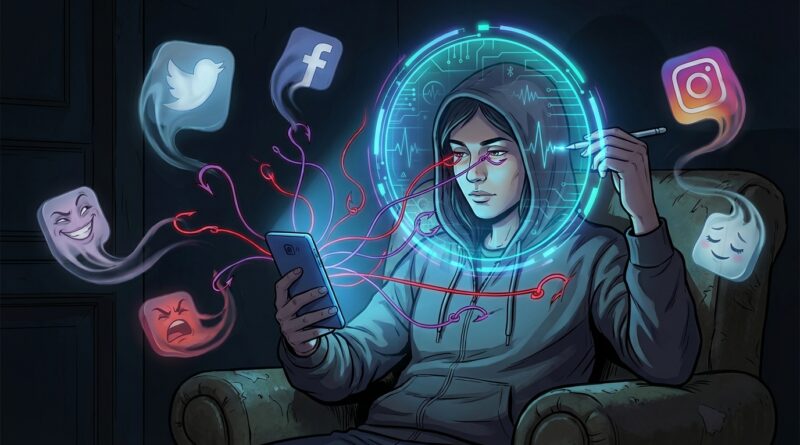
How to Build a Personal ‘Influence Firewall’ So Social Media Can’t Hack Your Emotions
You open Instagram for a quick break. Ten minutes later, you feel slightly worse about your life, strangely interested in a product you did not need, and emotionally wound up for reasons you cannot quite name. That is not you being weak. It is the system doing what it was built to do. TikTok, Instagram and similar apps are very good at learning which images, sounds, faces and stories can steer your attention and your mood. That is why “just delete the app” rarely helps, and “have more willpower” helps even less. What works better is building a personal influence firewall. Think of it like spam filtering for your emotions. You do not need to become cold, cynical or offline. You just need a few simple habits that help you spot the hook before it sinks in, name what is happening, and choose your next move instead of being quietly pushed into it.
⚡ In a Hurry? Key Takeaways
- Your best defence is not quitting social media. It is learning to spot the emotional tricks feeds use and pausing before they shape your mood or choices.
- Use a simple three-step filter: name the hook, check your body, then decide whether to scroll, save, mute or leave.
- If a post makes you feel urgent, inadequate or strangely obsessed, treat that as a warning light, not a command.
What an “Influence Firewall” Actually Means
If you know how to resist social media psychological influence, you stop treating every emotional reaction as truth.
An influence firewall is a mental filter. It sits between the feed and your nervous system. The goal is not to stop feeling things. The goal is to stop platforms, creators and advertisers from getting a free pass into your head.
Real firewalls do not block the whole internet. They inspect traffic and catch suspicious stuff. Your personal version works the same way. You look at what is coming in and ask, “Is this informing me, entertaining me, or trying to hijack me?”
Why Social Media Feels So Personal
The old internet showed the same thing to almost everyone. Modern feeds do not. They test you.
They notice what you watch twice. What you rage at. What you linger on. What makes you compare yourself. What makes you buy. Then they send you more of it.
That is why the manipulation can feel spooky. It often does not look like manipulation. It looks like a funny video, a skincare routine, a “day in my life” clip, or a motivational speech. But underneath that soft surface is a recommendation machine asking one question over and over: “What keeps this person emotionally engaged?”
The feed is not neutral
This is the first thing to accept. Your feed is not a window. It is a persuasion environment.
Some posts are trying to get your attention. Some are trying to get your money. Some are trying to shape your beliefs. A lot are trying to do all three at once.
The Four Most Common Emotional Hooks
1. Comparison hooks
These posts make your life feel smaller, duller or behind schedule. They often feature beauty, wealth, fitness, parenting, productivity or relationships.
The trick is not always envy. Sometimes it is aspiration wrapped in shame. “You could have this too, if you were doing life correctly.”
Your firewall response: This post is selling me a gap between who I am and who I should be.
2. Urgency hooks
These create pressure. Limited-time offers. “Run, don’t walk.” “Everyone is talking about this.” “Get it before it sells out.” “Use this before it gets banned.”
Urgency short-circuits calm thinking. It pushes you to act before you ask whether you even care.
Your firewall response: If I feel rushed, I wait.
3. Identity hooks
These pull on your need to belong. The message might be subtle. Smart people use this. Good parents buy this. High-value people live like this. Real men do this. Emotionally evolved women avoid that.
This is powerful because it does not just sell a product or opinion. It sells a self-image.
Your firewall response: I do not need to prove who I am to an app.
4. Outrage hooks
Nothing keeps people scrolling like anger. Feeds know this. So do creators.
Some outrage is real and worth your attention. But a lot of it is engineered to keep you activated, tribal and easy to predict.
Your firewall response: Strong emotion is not proof. It is a cue to slow down.
The 10-Second Firewall Check
You do not need a long ritual. You need a tiny pause you can actually use.
Try this whenever a post grabs you hard.
Step 1: Name the hook
Ask, “What is this trying to make me feel?”
Examples:
- Insecure
- Left out
- Urgent
- Horny
- Angry
- Greedy
- Inspired but also weirdly inadequate
Step 2: Check your body
Your body often notices manipulation before your mind does.
Ask:
- Did my chest tighten?
- Did I hold my breath?
- Do I suddenly want to buy, reply, argue or keep scrolling?
Step 3: Choose a move
Now pick one:
- Scroll past
- Mute the account
- Save it for later when you are calmer
- Leave the app
- Write down what it was trying to do
That is your firewall in action. Small. Fast. Practical.
How to Make the Algorithm Less Powerful Over You
You may not control the algorithm, but you do train it. Every pause, follow, watch, share and comment is a vote.
Starve what messes with you
If an account reliably leaves you agitated, obsessed or inferior, stop feeding it attention. Do not hate-watch it. Do not argue in the comments. That still teaches the app that this content works on you.
Feed what steadies you
Follow accounts that teach, calm or genuinely amuse you without leaving a psychological hangover.
If you want the simplest rule of all, use this one: after spending time with an account, do you feel clearer or more scrambled?
Use the built-in controls
People forget these exist, but they matter.
- Mute people without unfollowing
- Mark videos “not interested”
- Turn off notifications
- Remove shopping alerts and promotional prompts
- Keep the app off your home screen if needed
This is not dramatic. It is maintenance.
Three Mental Scripts That Stop a Lot of Bad Decisions
“This is a performance, not a full life.”
Use this for lifestyle content, couple content, body content and luxury content.
Most feeds are highlight reels with good lighting and hidden costs. Even when the emotion is real, it is still edited.
“A feeling is happening. It is not an instruction.”
This one helps with shopping, doomscrolling and comment fights.
Feeling tempted does not mean buy. Feeling angry does not mean reply. Feeling left behind does not mean your life is failing.
“If this matters, it will still matter in 20 minutes.”
This destroys fake urgency.
Very few online demands are actually urgent. Most are just well-timed.
How Influencers Quietly Borrow Your Trust
The strongest influence rarely feels like an ad. It feels like a relationship.
Creators talk to the camera like a friend. They share vulnerable moments. They tell you what worked for them. Over time, your brain starts to file them under “trusted person” instead of “marketing channel.”
That does not mean every influencer is fake. Plenty are honest. The point is that closeness itself can be used on you.
Watch for these trust shortcuts
- “I never promote things I don’t love”
- “You guys kept asking”
- “This changed my life”
- “I’m being totally real with you”
- “I almost don’t want to share this”
These phrases lower your guard. That is why they work.
Your firewall line: Warmth is not proof. Familiarity is not evidence.
Build Friction on Purpose
The apps are designed to remove friction. You should add some back.
Good friction ideas
- Log out after each session
- Use app timers
- Keep shopping apps off your phone
- Wait 24 hours before buying anything you saw in a feed
- Do not use social media in bed or the first 30 minutes after waking
None of this is about punishment. It is about creating one extra beat between impulse and action.
What to Do Right After a Feed Wrecks Your Mood
Sometimes the firewall fails. That is normal. The key is recovery.
Try the reset in this order
- Put the phone face down.
- Name the mood. Envy, agitation, sadness, craving, anger.
- Stand up and move for two minutes.
- Ask, “What did I just consume?”
- Mute or unfollow the source if this is a pattern.
That last step matters. A lot of people keep returning to the very content that keeps destabilizing them, then blame themselves for being affected. That is like standing next to a speaker at full volume and feeling guilty that your ears hurt.
Teach Yourself to Notice the “Aftertaste”
One of the best ways to learn how to resist social media psychological influence is to stop judging posts by how they feel in the moment and start judging them by the aftertaste.
Ask yourself:
- Do I feel mentally scattered after this account?
- Do I want things I did not want 15 minutes ago?
- Do I feel less patient with my real life?
- Do I feel oddly dependent on checking back?
The aftertaste tells the truth. Some content gives you energy. Some content borrows it.
Your Goal Is Not Perfection
You are not trying to become impossible to influence. Nobody is. Humans are social creatures. We copy, absorb, compare and react. That is normal.
The goal is much more realistic. You want to notice sooner. Recover faster. Hand over less of your attention, mood and spending power by accident.
That is what psychological self-defence looks like in daily life.
At a Glance: Comparison
| Feature/Aspect | Details | Verdict |
|---|---|---|
| Willpower alone | Relies on resisting highly tuned emotional triggers in real time, often when you are tired or distracted. | Weak long-term defence |
| Deleting every app | Can help for a reset, but it is often too extreme to stick and does not teach you what to watch for. | Useful short break, not a full skill |
| Influence firewall habits | Uses quick awareness tools, better feed training, friction and recovery steps to reduce manipulation. | Best practical everyday approach |
Conclusion
People are finally talking about how much emotional manipulation is baked into feeds, recommendation systems and influencer culture. What is still missing is the practical part. The small tools you can use while your thumb is already scrolling. That is where a personal influence firewall helps. It turns a vague feeling of “this app is messing with me” into something clear and manageable. You learn to spot the hook, name the pressure, and interrupt the script before it runs your mood, your beliefs or your wallet. You do not need perfect discipline. You need better pattern recognition. Once you have that, social media starts to lose some of its magic trick. And that is a good thing. You feel sharper, calmer and much less easy to play every time you pick up your phone.